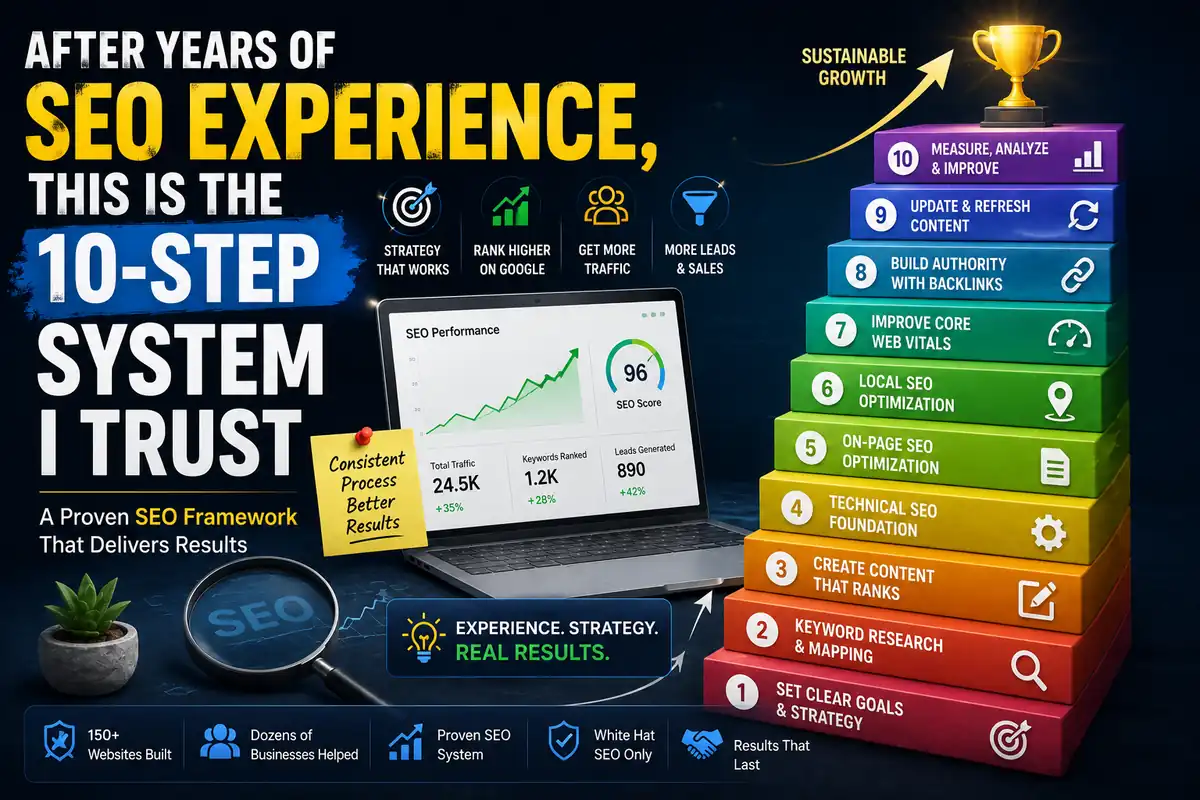
I have built over 150 websites and managed SEO for dozens of small businesses across Lucknow. Some ranked on page one within weeks. Others took months. A few never made it despite solid effort.
The difference wasn't luck. It was a repeatable system.
After years of trial and error, I have settled on a 10-step SEO process that consistently delivers results. No shortcuts, no tricks, no advice I haven't tested myself. Here it is.
Last updated: July 12, 2026
75% of users never scroll past the first page of search results. 67% of all clicks go to the top five organic listings.
- Start With Keyword Strategy
- Build Content That Answers Real Questions
- Fix Technical SEO Fundamentals
- Optimise for Local Search
- Earn Backlinks the Right Way
- Improve Core Web Vitals and Page Speed
- Structure Your Site Logically
- Track What Matters
- Refresh and Repurpose Old Content
- Stay Consistent — SEO Is a Marathon
- Frequently Asked Questions
- Get Your Free SEO Audit
Why Most SEO Advice Is Noise
Search for "SEO tips" and you will find thousands of articles. Most tell you the same things — write good content, build backlinks, use keywords. They are not wrong. They are just incomplete.
The real challenge is not knowing what to do. It is knowing what to do first, next, and consistently. A system beats a collection of tips every time.
This 10-step system is ordered by impact. Each step builds on the previous one. Skip around and you risk wasting effort on tactics that matter less until the foundation is solid.
Step 1: Start With Keyword Strategy, Not Guesswork
Understand what your customers are searching for
Keyword strategy is the foundation of everything. Without it, you are publishing content into a void.
Every SEO campaign I run starts with the same exercise: list every term a potential customer might type into Google to find your business. These are your seed keywords.
For a web design agency, seeds might include: web design company, website developer, best web designer. For a restaurant: best restaurant near me, family dining, catering service.
Once you have seeds, expand them using tools like Google Keyword Planner or Ubersuggest. Look for long-tail keywords (3-5 word phrases) with clear search intent.
- Seed keywords — broad terms related to your business
- Long-tail keywords — specific phrases with high purchase intent
- Question keywords — queries starting with how, what, why, where
- Local keywords — terms with your city or neighbourhood name
My rule: If a keyword would change how I build a page, it belongs in the strategy. If it is just a high-volume vanity term, skip it.
Step 2: Build Content That Answers Real Questions
Write for people, optimise for search engines
Content is not about word count. It is about whether the reader walks away satisfied.
Google is exceptionally good at understanding whether content actually helps users. The old tricks — stuffing keywords, writing thin pages, churning out 500-word blog posts — stopped working years ago.
Instead, I follow one principle: answer the question completely. If someone searches "how much does a website cost in India", they want a clear answer with real numbers, not a vague blog post that dances around the topic.
For each keyword in your strategy, create a piece of content that:
- Answers the search query directly and early in the page
- Includes examples, data, or screenshots where helpful
- Links to related content on your site for deeper reading
- Has a clear call to action for what to do next
This approach helped one of our clients go from zero organic traffic to over 2,000 monthly visitors within six months — entirely from informational blog content. Read our complete SEO guide for beginners for a deeper dive into content strategy.
Step 3: Fix Technical SEO Fundamentals
Make sure Google can find, crawl, and index your site
Technical SEO is not glamorous. But without it, nothing else matters.
I have audited sites with excellent content that ranked poorly because Google simply could not crawl them properly. Technical SEO is the gatekeeper — if your site fails here, your content never gets a chance to rank.
Run your site through Google Search Console and check for these issues:
- Crawl errors — pages Google cannot reach (404s, server errors)
- Index coverage — pages that should be indexed but are not
- XML sitemap — submitted and error-free
- Robots.txt — not blocking important pages
- HTTPS — valid SSL certificate with no mixed content warnings
- Canonical tags — no duplicate content confusion
- Redirects — proper 301 redirects for moved pages
Quick win: Fixing crawl errors and submitting a clean sitemap often produces ranking improvements within two to four weeks.
Step 4: Optimise for Local Search
Claim your territory on Google Maps and local search
For small businesses, local SEO often delivers faster returns than broad organic SEO.
If your business serves customers in a specific area — Lucknow, Delhi, Kanpur — local SEO is your fastest path to page one. I have seen businesses go from invisible to appearing in the local pack within weeks by following these steps.
Start with your Google Business Profile. Fill every field: business name, address, phone number, website, categories, services, hours, photos. Then verify it. Then post regularly.
We wrote a detailed Google Business Profile setup guide for Lucknow businesses that walks through every step.
Beyond Google, ensure your Name, Address, and Phone number (NAP) is consistent across every directory — Justdial, Sulekha, IndiaMart, Facebook, and industry-specific listings. Inconsistent NAP data confuses Google and hurts local rankings.
46% of all Google searches have local intent. Businesses with complete Google Business Profiles are 2.7x more likely to be considered reputable.
Sources: Google, BrightLocal.
Step 5: Earn Backlinks the Right Way
Build authority through quality links, not spam
A single relevant backlink is worth more than a hundred directory links.
Backlinks remain one of Google's top three ranking signals. But the days of buying links or submitting to every free directory are over. Google's Penguin algorithm penalises manipulative link practices.
Effective link building takes effort but pays off for years:
- Guest posting — write useful articles for industry blogs and local news sites
- Local partnerships — get listed on your chamber of commerce, supplier websites, or partner directories
- Resource pages — create something so useful that other sites naturally link to it (a guide, a tool, original research)
- Broken link building — find broken links on relevant sites and suggest your content as a replacement
My rule: If a link feels easy to get, it is probably not worth having. Quality over quantity, always.
Step 6: Improve Core Web Vitals and Page Speed
Speed and stability are ranking factors — and user expectations
A fast site ranks better and converts better. Google measures this through Core Web Vitals.
Core Web Vitals are a set of real-world metrics that measure user experience: loading speed (LCP), interactivity (FID/INP), and visual stability (CLS). Google made them ranking factors in 2021, and they have only grown in importance.
Test your site with Google PageSpeed Insights. If your scores are below 90 on mobile, you have work to do.
Common fixes that make the biggest difference:
- Optimise images — use WebP format, serve responsive sizes, lazy-load below-the-fold images
- Minify CSS and JavaScript — remove unused code and whitespace
- Leverage browser caching — set cache headers for static assets
- Reduce server response time — upgrade hosting if needed, use a CDN
- Eliminate render-blocking resources — defer non-critical CSS and JS
We cover this in detail in our website speed optimization guide. The short version: every 1-second delay in page load time reduces conversions by up to 20%.
Step 7: Structure Your Site Logically
Help users and search engines navigate with clarity
Site structure is the framework that holds your SEO together.
A well-structured site helps Google understand which pages are most important and how they relate to each other. It also keeps visitors engaged longer by making related content easy to find.
Key principles I follow:
- Flat hierarchy — any page should be reachable within three clicks from the homepage
- Descriptive URLs — example.com/services/web-development rather than example.com/page?id=7
- Internal linking — every page should link to and from relevant related pages
- Breadcrumbs — show users exactly where they are in the site structure
- Sitemap — keep your XML sitemap updated whenever you add or remove pages
Good site structure also passes link equity (PageRank) throughout your site. A page buried under five levels of navigation with no internal links pointing to it has almost no chance of ranking.
Step 8: Track What Matters
Measure what actually drives business value
Vanity metrics like total keyword rankings tell you nothing about revenue.
I have lost count of how many business owners told me they rank for 500 keywords but have no idea how many of those keywords bring customers. The number of keywords you rank for is not a business metric.
Here is what I track for every client:
- Impressions and clicks (Google Search Console) — are people seeing and clicking your site?
- Click-through rate — are your titles and meta descriptions compelling enough?
- Average position — is your visibility improving over time?
- Conversions — how many visitors fill a form, call, or make a purchase?
- Organic traffic trend — is your total organic traffic growing month over month?
Set up Google Analytics 4 and connect it to Search Console. Review performance monthly. If impressions are up but clicks are flat, work on titles and meta descriptions. If traffic is up but conversions are flat, work on your site's messaging and calls to action.
My rule: If a metric cannot be tied to a business outcome (lead, sale, sign-up), stop tracking it.
Step 9: Refresh and Repurpose Old Content
Old content is a goldmine most businesses ignore
Updating and republishing existing content often produces faster gains than creating new pages.
Your existing blog posts and service pages have accumulated some authority over time. Google trusts them. Instead of always creating new content, go back and improve what you already have.
This is one of the highest-ROI activities in SEO. I have seen pages jump from page five to page one simply by updating statistics, improving readability, and adding stronger internal links.
How I refresh content:
- Update statistics and examples to the current year
- Improve headings and subheadings for clarity
- Add new sections that answer emerging questions
- Strengthen internal links to newer related content
- Update the publish date and add a note about what changed
- Check that all external links still work
Step 10: Stay Consistent — SEO Is a Marathon
Small actions repeated consistently outperform occasional bursts
The single biggest reason SEO fails is not poor strategy — it is stopping too early.
I have seen businesses do everything right for three months and then quit because they were not on page one yet. SEO does not work that way. Google needs time to discover, crawl, index, evaluate, and trust your content. That process takes months, not weeks.
Here is what consistency looks like in practice:
- Publish at least two blog posts per month
- Check Google Search Console weekly for new issues
- Review rankings and traffic monthly
- Refresh one old piece of content every month
- Build at least one quality backlink per month
The businesses that win at SEO are not the ones with the biggest budgets. They are the ones that keep showing up, month after month, without panicking when results do not come overnight.
Want a custom SEO plan for your business?
I will audit your current site and build a step-by-step SEO roadmap tailored to your business and local market.
Get Your Free SEO AuditFrequently Asked Questions
How long does SEO take to show results?
Most businesses start seeing meaningful traffic increases within 4 to 8 months of consistent SEO effort. Some quick wins — like fixing technical issues or optimising a Google Business Profile — can show improvement in 2 to 4 weeks.
Can I do SEO myself or should I hire someone?
You can handle basic SEO yourself — writing content, claiming your Google Business Profile, fixing broken links. But technical SEO, competitor analysis, backlink building, and ongoing strategy are best handled by an experienced agency. Most small businesses find that a hybrid approach works well.
How much does SEO cost for a small business?
SEO costs vary widely. Monthly retainers from Indian agencies typically range from ₹8,000 to ₹25,000 for small businesses. One-time technical SEO audits cost ₹5,000 to ₹15,000. These investments usually pay for themselves through increased organic traffic and leads.
What is the most important SEO factor in 2026?
Content quality and user experience are the two most critical factors. Google's algorithms are better than ever at understanding whether content genuinely helps users. Alongside this, Core Web Vitals and mobile usability remain essential for ranking.
Does SEO still work for local businesses?
Absolutely. Local SEO is often more effective for small businesses than broad SEO because the competition is more targeted. A well-optimised Google Business Profile combined with locally relevant content can put a small business on the first page for service-area searches within months.
Ready to put this system to work?
Book a free 30-minute consultation and I will show you exactly which steps will make the biggest difference for your business.
Book a Free Consultation