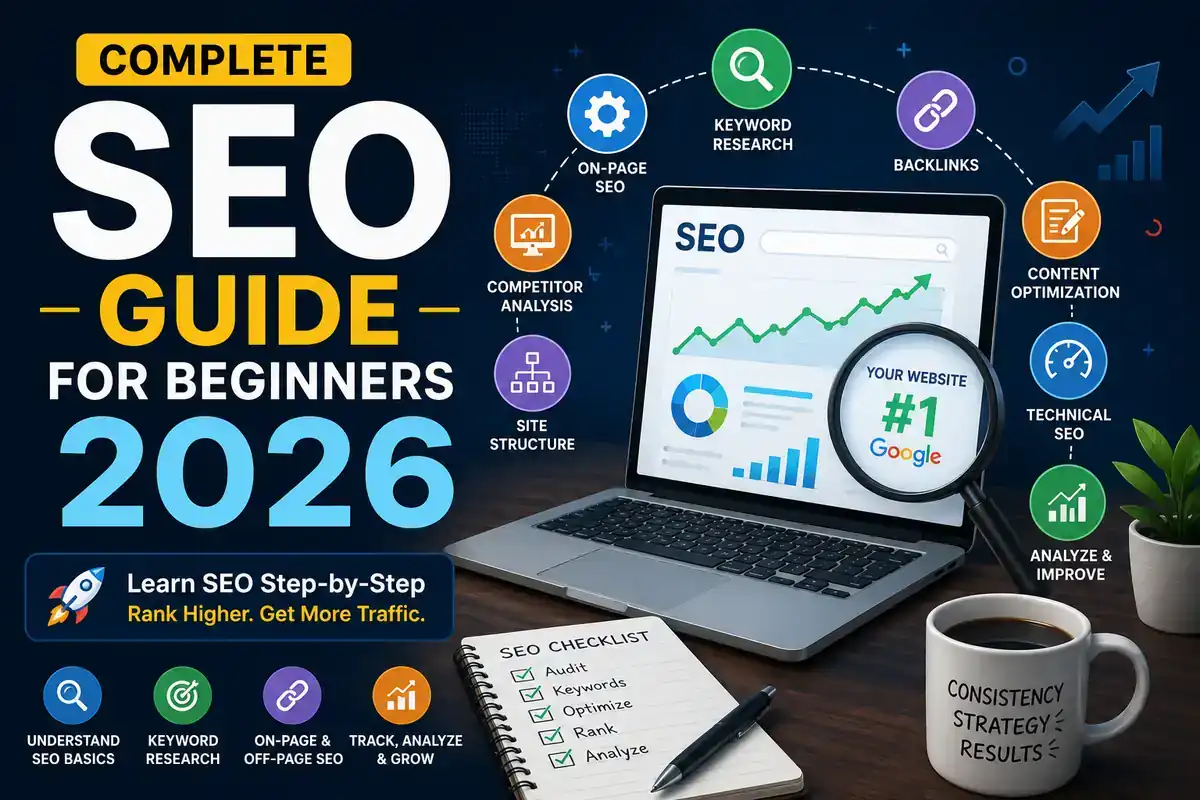
In This Guide
What Is SEO in 2026? (Beginner-Friendly)
SEO stands for Search Engine Optimisation. In simple terms, it’s the process of making your website more useful and understandable so that Google is more likely to show it when people search for what you offer.
Think of it like this: if your shop is in a narrow lane off Hazratganj, you still want people to find it easily. SEO is like putting clear signboards, keeping the shop clean and making sure people who come in get what they expected. Only here, your “lane” is the search results page.
SEO is not about getting random visitors. It’s about bringing people who are already searching for what you sell — coaching, salon services, courses, products or consultations.
When you do SEO well, people find you naturally through Google search, without you paying for every click like you do with ads.
SEO is a long-term game. You won’t jump from nowhere to #1 in a week, but you can build steady, compounding results over months.
Why SEO Matters for Small Businesses in India
In 2026, almost every customer checks Google at some point before making a decision — whether they are looking for “best coaching in Aliganj”, “wedding photographer in Gomti Nagar” or “digital marketing agency in Lucknow”. If you are invisible there, you are missing out.
Related: How to Choose the Best Digital Marketing Agency in Lucknow
Good SEO helps you:
- Show up when people search for your services and city.
- Look more trustworthy when people research your brand name.
- Reduce long-term dependence on paid ads and discounts.
- Turn your website from a digital brochure into a lead machine.
The 4 Main Pillars of SEO
For beginners, it helps to think of SEO as four connected pillars. You don’t need to master everything on day one, but you should understand the basics of each pillar.
Making sure your site is crawlable, fast, mobile-friendly and well-structured, so search engines can access and understand it.
- Fast loading on mobile.
- Secure (HTTPS) and no major errors.
- Proper URLs, sitemaps and basic structure.
Optimising each page’s visible content and HTML tags so Google understands what it’s about.
- Titles, meta descriptions and headings.
- Good keyword placement.
- Clear internal linking between pages.
Creating genuinely helpful pages and blog posts that answer your audience’s questions better than your competitors do.
- Service pages that explain clearly.
- Blogs that solve real problems.
- Case studies and success stories.
Building authority and trust through links, reviews and consistent business information across the web.
- Quality backlinks, not spam.
- Google Business Profile & reviews.
- Listings on relevant local directories.
Quick Start: 5 SEO Steps for Complete Beginners
If you feel overwhelmed, start with this minimal 5-step SEO plan. You can implement most of it in a week, even as a beginner.
Quick Wins for Absolute Beginners
- Add your main service + city into your homepage title and meta description in a natural way.
- Make sure every service has its own dedicated page, not just a list on one generic page.
- Embed a Google Map and clear contact info on your Contact page for local trust.
- Fix obvious speed issues: huge images, unnecessary sliders, heavy unused plugins.
On-Page SEO Basics You Must Get Right
On-page SEO is where most beginners can make the biggest impact with the least technical headache. These are the elements you control directly on each page.
Page Titles and Meta Descriptions
Your page title is the blue link text that shows in Google results. The meta description is the short paragraph below it. Together, they act like a mini-ad for your page — and they tell Google what the page is about.
- Include your main keyword and city where relevant (for example, “Affordable Web Design Services in Lucknow | GoPixel”).
- Keep titles clear and readable, not stuffed with repeated keywords.
- Use meta descriptions to explain benefits and add a soft call to action.
Headings and Content Structure
Use headings (H1, H2, H3, etc.) to break your page into logical sections. This helps both readers and search engines understand your content.
- Only one H1 per page, matching the main topic.
- Use H2s for major sections (like “Services”, “Pricing”, “FAQs”).
- Include keywords naturally in headings where it makes sense.
Internal Links
Linking between your own pages helps users discover more and helps search engines understand which pages matter most.
- From your Home page, link to key services and important landing pages.
- From blog posts, link to related services (“learn more about our web design services in Lucknow”).
- Use descriptive anchor text instead of “click here”.
Content & Keywords for Beginners
At the heart of SEO is content that answers what people are actually searching for. You don’t need to be a professional writer; you just need to be clear, honest and helpful.
How to Find Simple Keywords
- Type your main service into Google and note the autocomplete suggestions.
- Scroll to the bottom of the results to see “related searches”.
- Use free or freemium tools to see basic search volumes and related ideas.
For a business in Lucknow, combine service + “in Lucknow” + nearby localities that people actually search (for example, “yoga classes in Gomti Nagar”, “digital marketing course in Aliganj”).
Turning Keywords into Content
Once you have a list of phrases, group them into topics. Each core topic becomes:
- A dedicated service page (for high-intent phrases like “wedding photographer in Lucknow”).
- Or a blog post (for questions like “how to choose a wedding photographer in Lucknow”).
Inside each page or article, write as if you are answering a real customer sitting in front of you. Use their language, not jargon.
Technical SEO Essentials (Without the Jargon)
You don’t need to become a developer to benefit from technical SEO. But you should know the basics and ask your developer or agency the right questions.
- Mobile-friendly: Check your site on common phone sizes. Text should be readable without zooming and buttons should be easy to tap.
- Speed: Large uncompressed images, heavy sliders and too many scripts slow you down. Aim for a clean, focused layout.
- HTTPS: Your site should show a lock icon in the browser; if not, talk to your host about SSL.
- Indexing: Make sure important pages are indexable and not accidentally blocked by settings or plugins.
- Clean URLs: Prefer simple URLs like
/services/web-design-lucknowover long, messy query strings.
If you work with GoPixel or another agency, make sure technical SEO is part of the discussion — not an afterthought once design is “finished”.
Local SEO for Lucknow & Indian Cities
If you serve customers in a specific city or region, local SEO is your best friend. It’s what helps you show up in the map pack and “near me” searches.
Related: Google Business Profile Setup Guide
Google Business Profile
For many local searches, your Google Business Profile is just as important as your website. Make sure you:
- Use the correct business name and category.
- Add address, phone number, website and opening hours.
- Upload real photos of your office, team and work.
- Post occasional updates or offers.
- Reply politely to all reviews (positive and negative).
Local Signals on Your Website
- Mention your city and key areas you serve in your content where it’s natural.
- Have a dedicated “Locations” or “Areas We Serve” section if you cover multiple neighbourhoods.
- Embed a map and directions on your Contact page to build trust.
Common Beginner Mistakes to Avoid
Before you go too deep, it helps to know what not to do. These are mistakes we see repeatedly when auditing sites for businesses in Lucknow and beyond.
🚫 SEO Mistakes That Hurt Beginners
- Keyword stuffing: Repeating the same phrase unnaturally just to “rank”. It makes content hard to read and can hurt you.
- Thin service pages: Single paragraphs that barely explain what you do. Aim for helpful, detailed explanations instead.
- Copying competitors: Duplicating text or structure from another site instead of creating your own, better version.
- Ignoring existing data: Not checking which pages already get impressions or clicks in Google Search Console before making changes.
- Expecting overnight results: Giving up after a month because “SEO doesn’t work”. It’s a compounding, long-term play.
A Simple 90-Day SEO Roadmap
To make this guide truly practical, here’s how a beginner can structure the first 90 days of SEO work without burning out.
At the end of 90 days, you should see better visibility for at least some of your target keywords, and you’ll have a clearer idea of what works for your specific niche and city.
How GoPixel Web Developers Can Help You With SEO
Because we are based in Lucknow and work with real local businesses every day, our SEO approach is practical, not theoretical. We care about leads, booked calls and walk-ins — not just rankings for vanity keywords.
When a business from Hazratganj, Gomti Nagar, Aliganj or Jankipuram approaches GoPixel for SEO, we typically:
- Audit your website, local presence and competition in your niche.
- Build a simple keyword and content plan based on how people actually search.
- Fix on-page and technical basics that hurt your visibility.
- Create or refine content that answers your ideal customers’ questions.
- Set up tracking so you can see what’s working over time.
Whether you just want a one-time SEO setup or an ongoing monthly plan, the goal is the same: turn your website into a growth asset that supports your business, instead of a page nobody finds.
Frequently Asked Questions
What is SEO in simple words for beginners?
SEO, or search engine optimisation, is the process of improving your website so that it appears higher in Google and other search engines when people search for the products or services you offer. It focuses on making your site easier to understand, faster, and more useful so that search engines trust and rank it better.
How long does SEO take to work for a new website?
For a new website, basic SEO results can take 3 to 6 months to show, depending on competition, content quality and how consistently you optimise the site. Competitive keywords and markets can take longer, while local, less competitive niches may see improvement sooner with the right strategy.
Can I do SEO myself as a beginner?
Yes, you can handle a lot of SEO basics yourself as a beginner, such as choosing good keywords, writing helpful content, optimising page titles and meta descriptions, and setting up Google Business Profile for local SEO. For technical fixes and advanced strategy, working with an experienced SEO professional or agency can speed up results.
Is SEO better than running ads for small businesses?
SEO and ads serve different purposes. SEO is better for long-term, compounding visibility that keeps working once your pages rank. Ads are better for quick, short-term results or time-sensitive campaigns. The best approach is often to use a mix: invest in SEO as the foundation and use ads strategically for faster wins.
Do I need SEO if I only get customers from social media?
Even if most customers currently come from social media, SEO is still important because many people will search your brand name or services on Google before contacting you. Having a strong, optimised website with clear information and local SEO makes you look more trustworthy and protects you if your social reach drops or platforms change.

Want a Beginner-Friendly SEO Plan for Your Business?
If you’re just getting started with SEO and feel overwhelmed, GoPixel Web Developers can help you prioritise what actually matters for your industry and city — and turn this guide into a simple 90-day action plan.
Get a Free SEO Strategy Call →