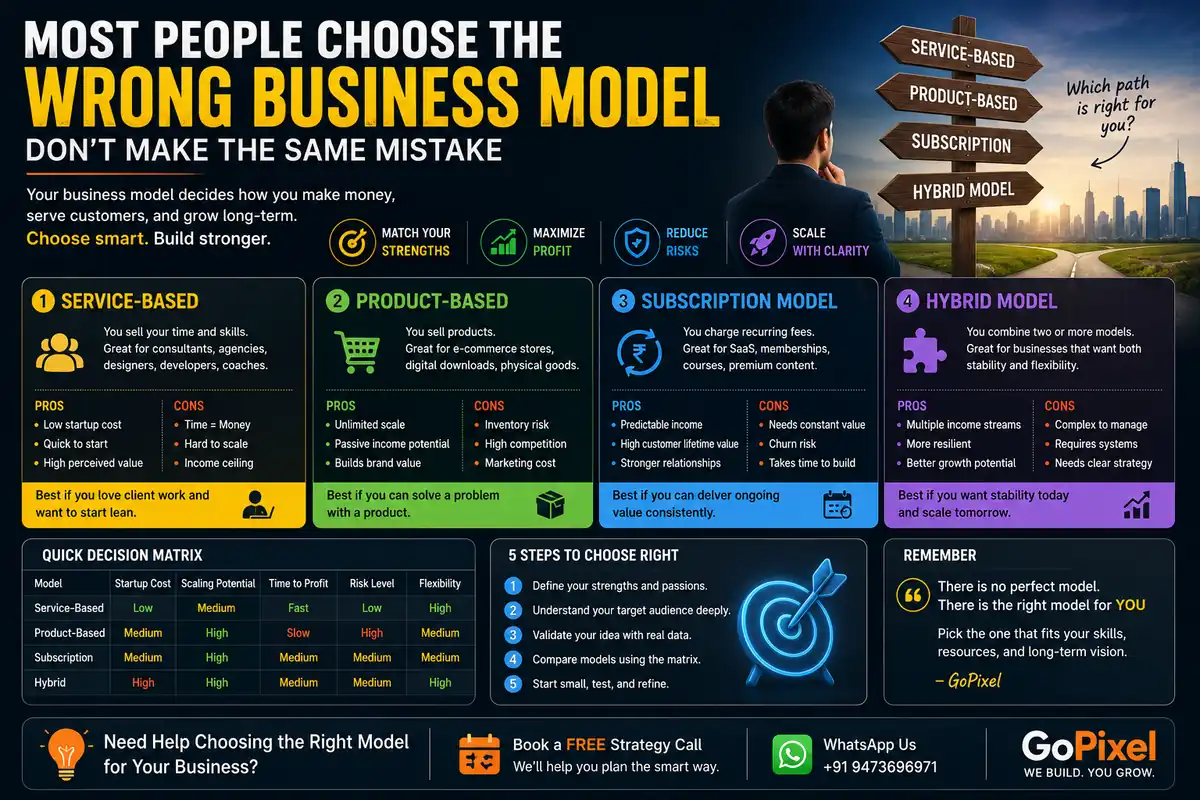
Most people who want to start an online business do the same thing. They pick a niche, design a logo, and build a website. Then they struggle to make sales because the fundamental question was never answered: what business model are you actually running?
A business model is not the same as a business idea. It is the specific way you create, deliver, and capture value. Two businesses in the same niche with different models will have completely different pricing, marketing, operations, and website requirements.
After building websites for over 150 businesses across India, I have seen which models work, which fail, and which founders wish they had chosen differently. Here is what I have learned.
Last updated:
90% of startups fail. Among the top reasons: no market need (42%) and running out of cash (29%). Both are often symptoms of choosing the wrong business model for the market you are trying to serve.
Sources: CB Insights, Startup Genome, Harvard Business Review.
Why Business Models Matter More Than Ideas
An idea without a model is just a hobby. I have seen talented designers struggle because they charged by the hour instead of by the project. I have seen e-commerce stores fail because they chose a low-margin commodity model instead of a curated premium model.
Your business model determines:
- How you price — one-time, recurring, tiered, or usage-based
- How you acquire customers — content marketing, paid ads, referrals, or partnerships
- What kind of website you need — lead generation, e-commerce, or membership portal
- How much capital you need upfront — services need almost none, products need inventory or development
- How scalable the business is — can you grow without proportionally increasing your time?
Most people choose their business model by accident. They copy what a competitor is doing or pick whatever feels easiest. That is how you end up in a model that does not fit your strengths, your market, or your long-term goals.
Model 1: Service-Based Business
Sell your skills, expertise, or time
You charge clients for specific outcomes: building a website, designing a logo, managing social media, consulting on strategy.
The service-based model is the easiest to start because it requires almost no capital. If you have a marketable skill, you can begin earning within days. This is why most freelancers, agencies, and consultants start here.
I started GoPixel as a service-based business. A client needed a website, I built it, they paid me. Simple. No inventory, no subscriptions, no complex infrastructure. Just skill + demand + delivery.
Where this model works: Web development, graphic design, content writing, digital marketing, consulting, coaching, photography, event planning, home services.
The trap: You trade time for money. Your income is capped by the number of hours you can work. Scaling means hiring more people, which adds complexity and risk. Many service business owners burn out because they never build anything that earns without their direct involvement.
My rule: Start with services to build cash flow and credibility. But have a plan to productise or add passive revenue within 12 to 18 months.
Model 2: Product-Based Business
Sell physical or digital products
You create or source a product once and sell it many times. Examples: e-commerce stores, digital downloads, software, packaged goods.
Products scale better than services because you are not trading time for money. A single digital product can sell 1,000 times with no additional effort. A physical product can be manufactured in bulk and sold through multiple channels.
But products require upfront investment. Physical products need inventory, packaging, and shipping. Digital products need development time before the first sale. Cash flow is slower because you spend first and earn later.
Where this model works: Handicrafts, fashion, electronics, health supplements, online courses, templates, software tools, e-commerce, print-on-demand.
The trap: Competition is fierce because products are easy to compare. Price wars, copycats, and thin margins are common. Without a strong brand or unique positioning, you end up competing on price — a race to the bottom.
My rule: If you choose products, pick a niche where you can differentiate beyond price. Premium positioning, better customer service, or unique sourcing give you pricing power.
Model 3: Subscription / Membership
Charge customers repeatedly for ongoing value
Monthly or yearly payments for access to a service, content, community, or product. Examples: SaaS, membership sites, retainer services, subscription boxes.
Subscription models are the most predictable and valuable. A customer who pays ₹1,000 per month for 24 months is worth ₹24,000 — not the ₹1,000 they pay today. This customer lifetime value (CLV) allows you to spend more on acquiring customers than one-time models can afford.
Businesses with recurring revenue also command higher valuations if you ever want to sell. A service business might sell for 2-3x annual profit. A subscription business can sell for 5-10x annual recurring revenue.
Where this model works: SaaS tools, membership communities, premium content, curated product boxes, maintenance retainers, ongoing coaching.
The trap: Customer acquisition is harder and more expensive. You need to convince someone to commit to an ongoing payment, not just a one-time purchase. Churn (customers cancelling) eats into your growth. If 10% of your customers leave each month, you need 10% new signups just to stay flat.
My rule: Test subscription willingness before building the full product. A simple landing page with a pre-sale offer tells you more than months of development.
Model 4: Hybrid Model
Combine multiple revenue streams
Run a service business alongside products or subscriptions. Use one stream to feed the other.
The smartest business owners I know run hybrid models. A web designer builds client sites (service) and sells website templates (product). A fitness coach runs 1-on-1 sessions (service) and sells a workout app subscription (subscription). An agency offers project work (service) and a monthly SEO retainer (subscription). Browse our portfolio to see examples of businesses using hybrid approaches.
Hybrid models are resilient because a slump in one stream is offset by growth in another. They also improve customer lifetime value because you have multiple ways to serve the same customer over time.
Where this model works: Almost any business can add a second stream. The key is making sure both streams serve the same audience so your marketing and positioning stay focused.
The trap: Complexity. Running two different business models under one roof pulls you in different directions. Your service clients need one thing; your product customers need another. Without clear systems, you end up mediocre at both.
My rule: Master one model first. Add the second only when the first is stable and profitable. A hybrid model executed poorly is worse than a single model executed well.
Quick Decision Matrix
Here is how the four models compare across the factors that matter most when starting out.
| Factor | Service | Product | Subscription | Hybrid |
|---|---|---|---|---|
| Startup cost | Low | Medium-high | Medium | Medium |
| Time to first revenue | Days-weeks | Weeks-months | Months | Weeks |
| Scalability | Low (time-bound) | High | Very high | Medium-high |
| Income predictability | Low | Medium | High | Medium-high |
| Competition level | Medium | High | Medium | Low-medium |
| Customer lifetime value | Low-medium | Medium | High | Very high |
| Complexity | Low | Medium | Medium-high | High |
| Best for beginners | Yes | With capital | With audience | With experience |
Start here if you have skills to sell
Service model. Low risk, fast revenue, builds your portfolio and reputation. Use it as a foundation for future growth.
Start here if you have capital
Product model. Higher risk but higher long-term potential. Choose a niche where you can differentiate on quality, not just price.
Start here if you have an audience
Subscription model. If people already trust you, recurring revenue is the most efficient path. Test pricing before building.
Start here if you have experience
Hybrid model. Combine service income with product or subscription revenue. Keep it simple and don't dilute focus.
How Your Website Should Match Your Business Model
Your website is not decoration. It is the engine that delivers your business model. Choosing the wrong website type for your model is one of the most expensive mistakes I see.
Here is how your website should align with your model:
- Service business: Your website must generate leads. Prioritise portfolio, testimonials, case studies, contact forms, and clear service descriptions. E-commerce functionality is unnecessary and distracting. Read our guide on HTML vs WordPress to choose the right platform for a service site.
- Product business: Your website must drive sales. You need a product catalogue, high-quality images, cart and checkout, payment gateway, shipping information, and return policy. Consider a dedicated e-commerce platform.
- Subscription business: Your website must onboard and retain members. You need a member portal, login system, recurring billing, content gating, and engagement features. Standard brochure sites cannot handle this.
- Hybrid business: Your website needs multiple sections that serve different purposes. A service section generates leads. A product section sells. A membership section retains. This requires careful information architecture and a more complex site structure.
If you are running a service business on a template designed for e-commerce, you are confusing your visitors. If you are selling products on a blog theme, you are losing sales. Your website and business model must be designed together.
Not sure which website type fits your model? We build websites for all four models. Our web development services page walks through the options.
Not sure which business model fits you?
Tell me about your skills, goals, and market. I will help you choose the right model and recommend the website structure to match it.
Get Your Free ConsultationFrequently Asked Questions
What is the easiest business model to start?
The service-based model is the easiest to start because it requires almost no upfront investment. You sell your existing skills or expertise. Freelancing, consulting, and agency work all fall under this model. You can start earning from your first client within days.
Which business model is most profitable?
Subscription and product-based models tend to be more profitable over time because they can scale without a proportional increase in time. A service business caps revenue at billable hours. A digital product or SaaS can serve thousands of customers with minimal additional cost.
Can I combine multiple business models?
Yes, and many successful businesses do. A common hybrid approach is offering services alongside digital products or subscriptions. Just be careful not to dilute your focus. Start with one model, master it, then add a second revenue stream.
How does my website affect my business model?
Your website is the delivery system for your business model. A service business needs lead generation pages. An e-commerce business needs a product catalogue and checkout. A subscription business needs a member portal. Choosing the wrong website type for your model is a common and costly mistake.
What business model works best for beginners in India?
For beginners with limited capital, the service-based model is usually the best starting point. Web development, content writing, graphic design, digital marketing, and social media management all have low barriers to entry. Once you build a client base and savings, you can expand into products or subscriptions.
Ready to build a website for your business?
Whether you are starting a service business, launching a product, or building a membership platform, we will build a website that supports your model and grows your revenue.
Start Your Project