You refresh Google Search Console. Your competitor is ranking for every keyword you're targeting. Their phone rings. Their contact form fills up. Meanwhile, your site sits there — looking fine, but generating nothing.
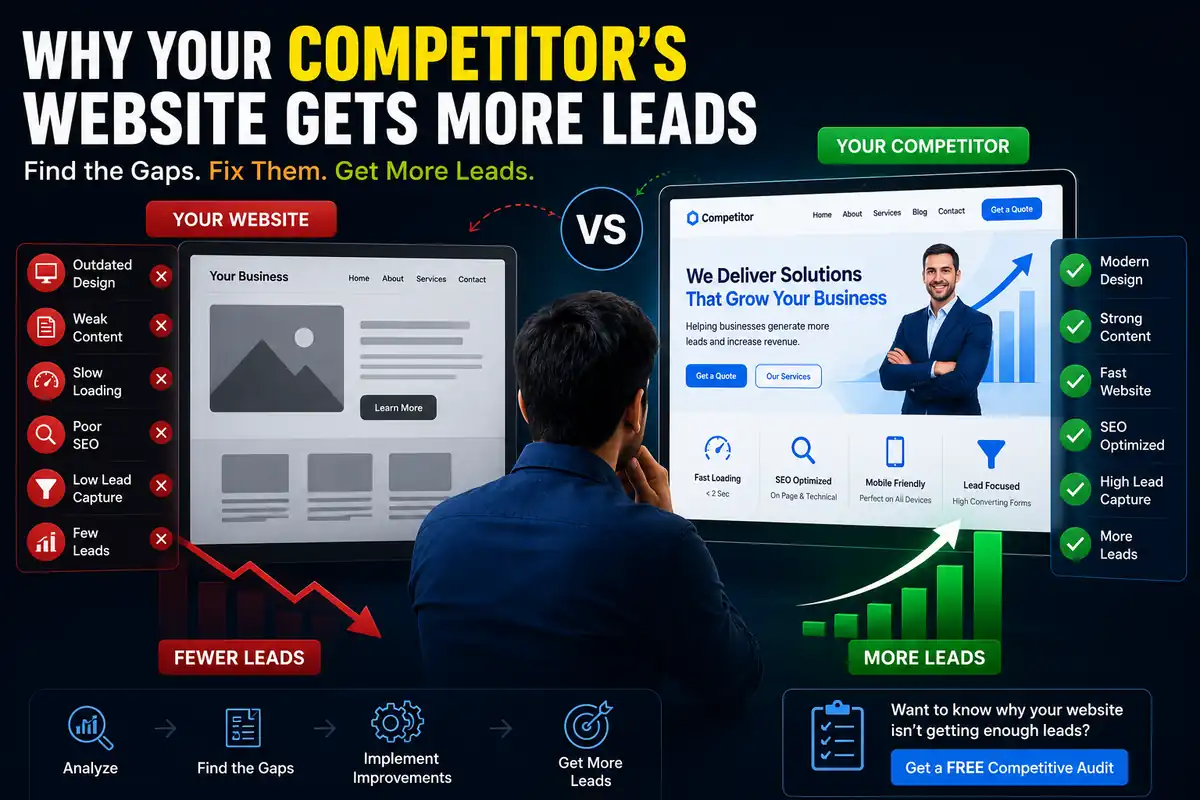
It's not luck. It's not budget. Your competitor has simply made a series of smarter decisions about their website: better design choices, clearer messaging, faster load times, stronger SEO, and more effective lead capture. The good news? Every one of those decisions can be replicated — often at a fraction of the cost you'd expect.
At GoPixel Web Developers in Lucknow, we've helped dozens of small businesses perform competitive audits and close the lead gap. In most cases, the competitor isn't doing anything mysterious. They're just doing the basics better. Here's exactly how to find out what they're doing — and how to overtake them.
75% of consumers judge a company's credibility based on its website design (Stanford Credibility Research). If your competitor's site looks more professional, they win trust before a single word is read.
Companies that blog generate 67% more leads per month than those that don't (HubSpot). If your competitor publishes regular content and you don't, that gap alone explains a lot.
47% of users expect a website to load in 2 seconds or less. A site that takes 3+ seconds loses nearly half its audience before they see the offer (various UX studies).
Sources: Stanford Credibility Research, HubSpot, Google.
In This Guide
Design & First Impressions
Your competitor's site loads fast, looks modern, and immediately communicates what they do. Yours might be cluttered, outdated, or unclear about your core offering. Design isn't just about looking pretty — it's about communicating professionalism and trust within seconds.
What to check
Open your competitor's site and yours side by side. Ask honestly: which one looks more trustworthy? Which one makes you want to do business with them? Which one clearly explains what they offer within 3 seconds? If the answer isn't yours, that's your first gap.
Common design gaps we see: outdated colour schemes, cluttered layouts, poor typography, inconsistent branding, no clear visual hierarchy, and low-quality images. Each of these erodes trust and reduces the likelihood that a visitor will take the next step.
Related: 15 common website design mistakes that drive customers away
Content & Messaging
Your competitor might not have better products or services. But they explain what they do more clearly, more persuasively, and more often. Content is the single biggest lead generation lever most small businesses ignore.
What to check
Count how many pages your competitor has versus you. Do they have a blog? Service pages that explain each offering in detail? Case studies or testimonials? FAQ sections that answer customer questions? Each page is a landing opportunity for search traffic and a chance to convince a visitor to contact you.
If your competitor publishes blog posts weekly and you have a static 5-page site, that gap is massive. Each blog post targets keywords your customers are searching for, builds authority, and gives Google a reason to rank you higher.
Related: Complete SEO guide for beginners
User Experience & Navigation
A visitor lands on your competitor's site and finds what they need in two clicks. On your site, they're still hunting. Navigation structure, internal linking, and page layout directly impact whether a visitor stays or bounces.
What to check
Visit your competitor's site with a task in mind — for example, "find their pricing" or "book a consultation." Time how many clicks it takes. Then do the same on your site. If your competitor makes it easier, they'll convert more visitors even with the same traffic.
Look for clear menu labels, a visible search function (for content-heavy sites), logical page hierarchy, breadcrumbs, and prominent calls to action on every page. These aren't luxury features — they're conversion essentials.
Speed & Mobile Performance
This is the most measurable gap — and often the most damaging. If your competitor's site loads in 1.5 seconds and yours takes 4 seconds, you're losing a significant percentage of visitors before they see anything.
What to check
Run both sites through Google PageSpeed Insights and GTmetrix. Compare the scores for mobile and desktop, and note the specific recommendations. A difference of even 1 second in load time can mean a 7% reduction in conversions.
Quick fix: Compress images, enable browser caching, minimise CSS and JavaScript, and switch to a faster hosting provider. Many small business sites can gain 2+ seconds of load time with these basic optimisations alone.
SEO & Visibility
Your competitor appears on the first page of Google for terms your customers are searching. You're on page 3 — or not ranking at all. This isn't about who has a bigger budget. It's about who has better technical SEO, more relevant content, and stronger on-page optimisation.
What to check
Search for your primary keywords. Note which competitors rank. Visit their pages and look at their title tags, meta descriptions, heading structure, image alt text, and schema markup. Also check their backlink profile using free tools like Ubersuggest or Ahrefs free version.
The most common SEO gaps: missing or poorly written title tags, no schema markup, slow page speed, poor mobile optimisation, thin content, no internal linking strategy, and zero blog content targeting long-tail keywords.
Lead Capture & Conversion
Even with equal traffic, your competitor may convert at a higher rate because their lead capture is better designed. The placement, design, and messaging of your calls to action directly determine how many visitors become leads.
What to check
Where are your competitor's CTAs? Do they have them above the fold, at the end of each page, in the header, as sticky buttons on mobile? What offers do they use — free consultations, quotes, downloads? How many form fields do they ask for? Each of these factors affects conversion rate.
Common conversion gaps: weak or invisible CTAs, forms that ask for too much information, no phone number prominently displayed, missing testimonials or trust signals, no live chat or WhatsApp integration, and no follow-up system for form submissions.
Your Site vs Competitor: Gap Table
Here's a practical framework to audit where you stand against your top competitor across every lead generation factor:
| Factor | Your Site | Competitor | Gap Severity |
|---|---|---|---|
| Design Quality | Outdated / amateur | Modern & professional | 🔴 High |
| Page Load Speed | 4+ seconds | Under 2 seconds | 🔴 High |
| Mobile Experience | Poor / broken | Smooth & responsive | 🔴 High |
| Content Depth | 5 static pages | Blog + 15+ pages | 🟡 Medium |
| SEO Foundation | No schema, weak tags | Full schema, optimised | 🔴 High |
| CTA Visibility | Hard to find | Prominent everywhere | 🟡 Medium |
| Trust Signals | None visible | Testimonials, reviews | 🟡 Medium |
| Blog Activity | No blog | Weekly posts | 🟠 Moderate |
Action Plan: How to Close the Gap
You don't need to fix everything at once. Prioritise by impact. Here's the order we recommend based on what we've seen work for small businesses in Lucknow:
Compress images, enable caching, minify code. This is the quickest win and affects both UX and SEO immediately.
Test every page on a phone. Fix overlapping elements, tiny buttons, and unreadable text. Mobile-first design is non-negotiable.
Every page should have at least one clear call to action — contact us, get a quote, call now. Make them visible without scrolling.
Write about the questions your customers ask most. Each post targets a keyword and brings in organic traffic over time.
Add local business schema, FAQ schema, and blog posting schema. Fix title tags, meta descriptions, and heading hierarchy.
Collect and display testimonials, showcase client logos, add case studies, and integrate WhatsApp for instant communication.
Frequently Asked Questions
Why does my competitor's website rank higher than mine?
Your competitor likely has better technical SEO (faster load times, proper schema, mobile optimisation), stronger content (more pages, regular blog posts, better keyword targeting), and more backlinks. Each of these gaps is fixable with a clear strategy.
How do I find out what my competitor is doing better?
Start with a manual audit: visit their site on desktop and mobile, check their speed with PageSpeed Insights, review their content quality and CTAs, and use tools like SEMrush or Ubersuggest to compare keywords. A professional website audit can uncover gaps you might miss on your own.
How can I generate more leads from my website?
Improve page load speed, add clear calls to action above the fold, optimise for mobile users, publish regular blog content targeting customer questions, add testimonials and trust signals, and ensure your contact forms work flawlessly.
What's the most important factor for website lead generation?
Speed and user experience are foundational — a slow or confusing site repels visitors before they see your offer. Beyond that, clear and compelling calls to action have the highest direct impact on conversion rates.
How long does it take to improve website leads?
Some fixes work immediately — improving CTA placement, fixing broken forms, adding testimonials. SEO improvements typically take 4–8 weeks to show results. A full website overhaul can take 3–6 weeks to build and another 4–8 weeks for SEO to stabilise.
Not Sure Where to Start?
Running a competitive audit can feel overwhelming, especially if you're not technical. You don't need to figure it all out alone. A structured website audit — done by someone who knows what to look for — can give you a clear, prioritised list of exactly what to fix and in what order.
At GoPixel, we offer competitive website audits that compare your site against your top 2–3 competitors across design, speed, SEO, content, and conversion. You get a clear report with specific recommendations, not generic advice.
Get a Free Competitive Audit
Not sure why your competitor is outranking and out-converting you? Get a free, no-obligation competitive audit from GoPixel. We'll analyse your site against your top 2–3 competitors and give you a prioritised action plan.
Get Your Free Competitive Audit → View Our Pricing →